
Year-End Tax Checklist for YA 2026: What to Do Before 31 December
Your YA 2026 tax bill is locked in on 31 December. Here's what's still worth doing before then, which Budget 2026 reliefs to use, and the filing dates for 2027.
By My Salary Info · 7 min read
Last updated: 8 October 2026
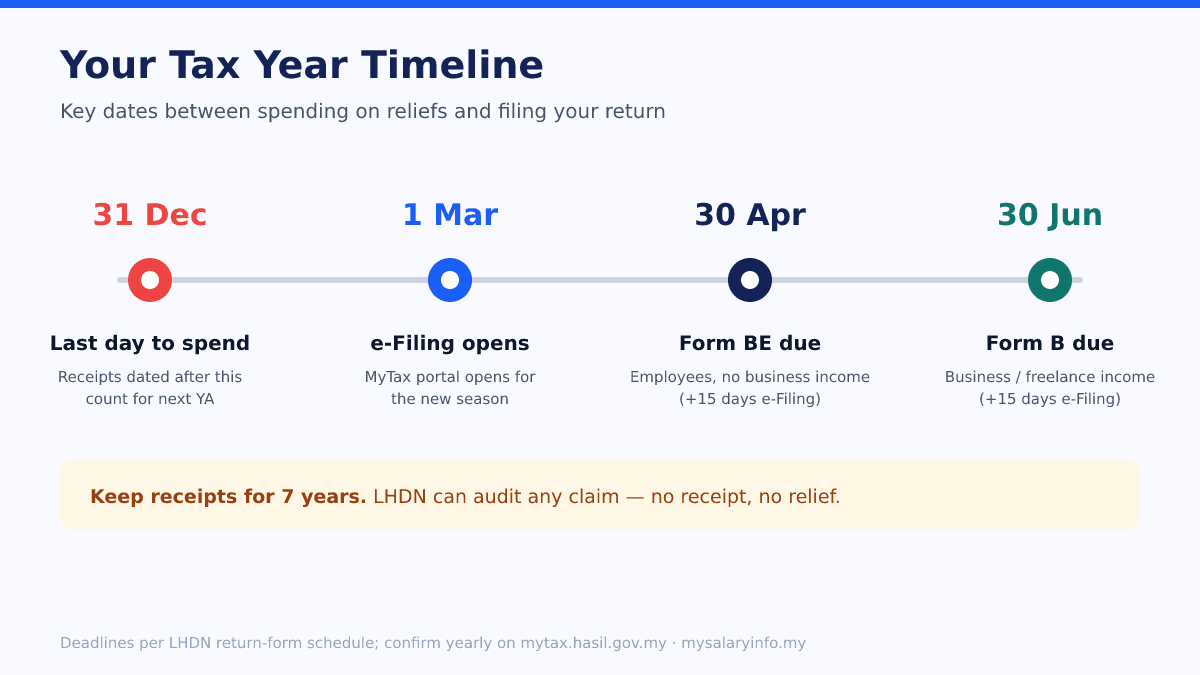
Malaysian income tax is worked out on the calendar year. Whatever you spend or save by 31 December 2026 counts towards YA 2026. Anything after that counts towards the following year. By the time e-Filing opens in March 2027, it's too late to change the result, and all you can do is claim what you already paid for.
So the last few months of the year are the time to check where you stand. Here's a practical checklist.
Key points
- Only spending and saving done by 31 December 2026 counts for YA 2026.
- Mandatory EPF can fill the RM4,000 category, while qualifying additional voluntary EPF may still use unused capacity in the separate RM3,000 life insurance / voluntary EPF category. Do not double-claim.
- The RM1,000 domestic tourism relief is for YA 2026 only, so use it this year if you can.
- Declare reliefs on Form TP1 now to lower your PCB for the rest of the year.
- Form BE is due 30 April 2027 and Form B 30 June 2027, each with a 15-day e-Filing grace period.
1. Check your EPF relief first
For YA 2025, HASiL lists two separate limits:
- Up to RM4,000: mandatory contributions to approved schemes or voluntary EPF contributions.
- Up to RM3,000: life insurance premiums, family takaful or additional voluntary EPF contributions.
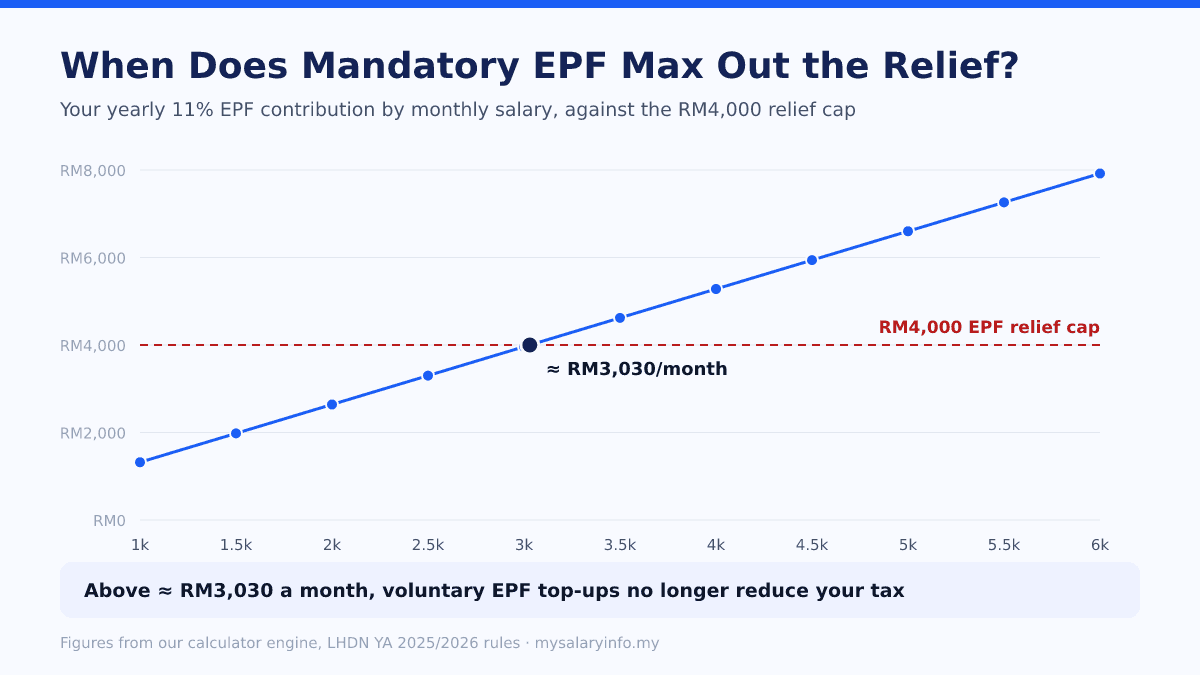
At an 11% contribution rate for 12 months, mandatory EPF reaches RM4,000 at a monthly salary of about RM3,030. That uses the first category, but qualifying voluntary top-ups may still use unused capacity in the second category. Do not claim the same contribution twice.
For example, if mandatory EPF already uses the RM4,000 category and you have RM1,000 of eligible life insurance premiums, up to RM2,000 of qualifying additional voluntary EPF could fill the remaining RM3,000 category. A deduction only saves tax where there is tax to reduce.
In the yearly calculator, enter the allocated amounts in the EPF field and the life insurance / additional voluntary EPF field. Check the applicable year and conditions in HASiL's tax relief schedule.
2. Use the reliefs that match what you'd buy anyway
- Lifestyle (RM2,500): a laptop, phone or tablet, books, your home internet bill, or a skills course.
- Sports (RM1,000): gym membership, sports gear, court or pool rental, race entry fees.
- Medical check-up (up to RM1,000): part of the RM10,000 medical relief. If your yearly check-up is due, book it before December.
- Vaccinations (up to RM1,000): from YA 2026 this covers any vaccine registered with the NPRA, for you, your spouse or your children.
- Domestic tourism (RM1,000, YA 2026 only): entrance fees to tourist attractions and cultural or arts events in Malaysia. It's a one-year relief, so this is the year to use it.
3. Family-related reliefs
- Childcare (RM3,000): from YA 2026 this covers registered day-care and transit care centres for children up to 12, as well as nurseries and kindergartens. Check the centre is registered with JKM or the Ministry of Education. Fees paid to an unregistered centre don't qualify.
- SSPN (RM8,000): the relief is on your net deposits for the year, so avoid withdrawing in the same year you deposit.
- Parents' medical care (RM8,000): treatment, care and check-ups for your parents.
- Education and medical insurance (RM4,000): premiums for policies covering you, your spouse or your children.
4. Don't buy things just for the relief
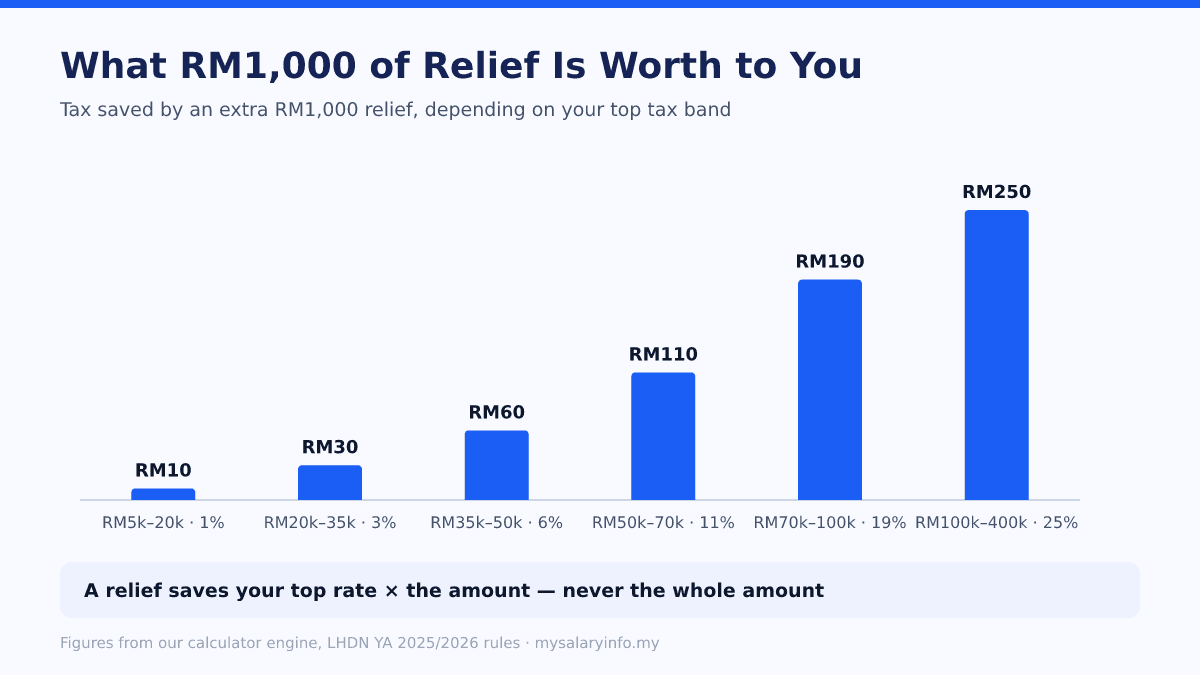
A relief saves you your marginal tax rate on the amount, not the whole amount. If your top rate is 11%, a RM1,000 purchase you only made for the relief saves you RM110 and costs you RM890.
The checklist above is about claiming what you'd spend on anyway, and timing it before 31 December where you can. If a purchase was already planned for January, moving it to December makes sense. Buying something you don't need doesn't.
A quick way to see what a relief is worth to you: enter your income in the yearly calculator, note the result, add the relief and compare.
A quick estimate
Say you earn RM5,000 a month and have already claimed the automatic reliefs. Your top rate is 6%. Every RM1,000 of relief you add saves RM60. If you earn RM8,000 a month, your top rate is 11%, so RM1,000 of relief saves RM110.
Enter your figures in the yearly calculator, then add the reliefs you still plan to use. The difference in the result is what the rest of this checklist is worth to you this year.
5. Zakat and donations
- Zakat and fitrah paid in 2026 come off your tax bill ringgit for ringgit, up to the tax you owe. If you usually pay zakat in a lump sum, paying before 31 December puts it into YA 2026. Keep the official receipt from your state zakat body.
- Donations to approved organisations (charities and institutions approved by LHDN, and government bodies) can be deducted, generally up to 10% of your aggregate income. Make sure the receipt shows the organisation's approval reference.
6. Fix your PCB before the year ends
If you've bought insurance, paid for medical treatment or spent on lifestyle items this year, you can declare them to your employer on Form TP1. Your PCB is recalculated from the next payroll run, so you get some of the benefit now instead of waiting for a refund in 2027.
If you changed jobs in 2026, check that you gave your new employer Form TP3. Without it, your new employer's PCB ignores what you earned earlier in the year, and you'll probably owe a balance when you file.
7. Get your paperwork in order now
- Receipts in your name. Keep them, or e-invoices, for seven years. A folder per year, on your phone or laptop, is enough.
- Insurance and SSPN statements. Insurers and PTPTN usually send annual statements early in the year. Keep them with your receipts.
- EA form. Your employer must give you your EA form by the end of February. Check that the salary and PCB figures match your payslips.
8. Bigger-ticket reliefs worth checking
- First home loan interest: if you signed the sale and purchase agreement for your first home between 2025 and 2027, you can claim up to RM7,000 a year of loan interest (homes up to RM500,000) or RM5,000 (RM500,000 to RM750,000), for three years. Ask your bank for an interest statement.
- Private Retirement Scheme (PRS): up to RM3,000, separate from EPF. Useful if your EPF relief is already maxed.
- Education fees for yourself: up to RM7,000 for recognised courses, including up to RM2,000 for approved upskilling courses. Pay the fee before 31 December to claim it this year.
Filing dates for YA 2026
- 1 March 2027 (approx.): e-Filing opens on MyTax.
- 30 April 2027: Form BE (employment income only). e-Filing usually gets a 15-day grace period, to 15 May.
- 30 June 2027: Form B (if you have business or freelance income). e-Filing grace period to 15 July.
Filing early also means any refund reaches you sooner.
Budget 2026 did not introduce a separate "home office equipment" or "digital learning" relief, whatever some social media posts say. Stick to the reliefs listed in LHDN's official schedule for the year.
What if you miss the deadline?
Late filing can attract a penalty under Section 112 of the Income Tax Act 1967, and tax paid late gets a 10% increase on the unpaid amount under Section 103, with a further 5% if it's still unpaid 60 days later. If you're owed a refund, filing late only delays your own money.
If you can't pay the full balance in one go, LHDN allows instalment arrangements. Apply through the MyTax portal or your LHDN branch before the due date rather than after.
Check the official sources
Check the applicable assessment year and eligibility conditions. Calculator estimates do not replace the official schedules or guidance.