
PCB Explained: Why Your Employer Deducts So Much Tax from Your Salary
What PCB (Potongan Cukai Bulanan) is, how employers work it out, real figures for RM3,000, RM5,000 and RM8,000 salaries, why it changes, and how to get back any excess.
By My Salary Info · 6 min read
Last updated: 25 September 2026
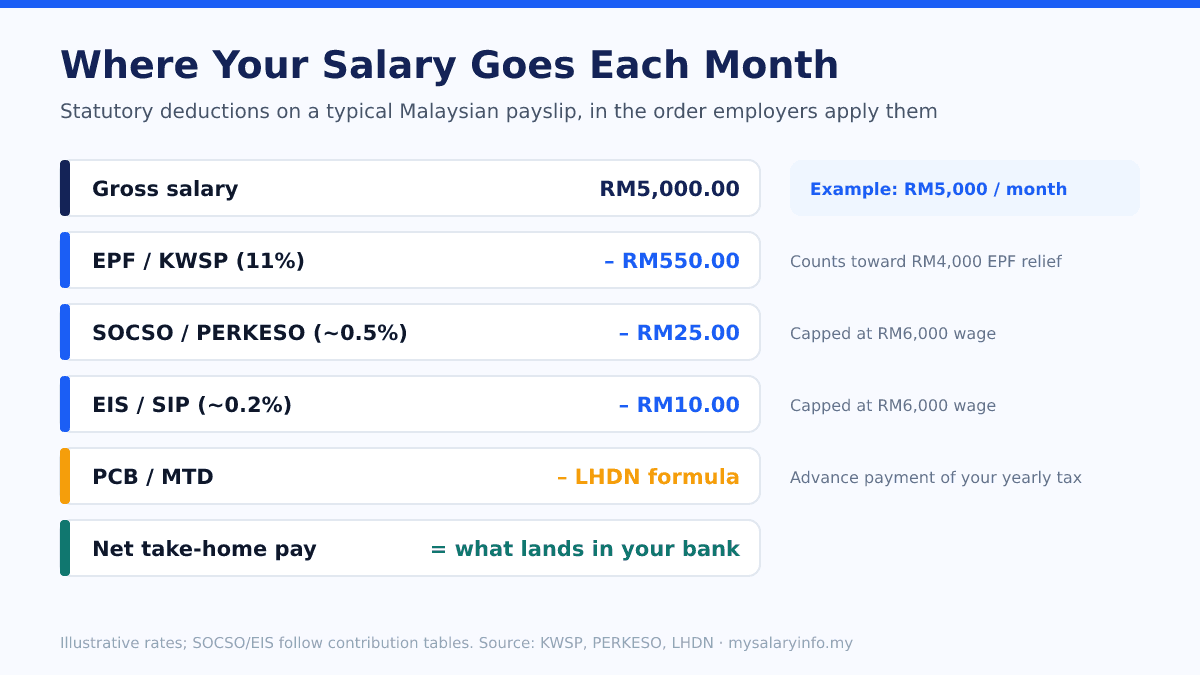
Most people first meet PCB on their first payslip, as a deduction they didn't expect. PCB (Potongan Cukai Bulanan), also called MTD or Monthly Tax Deduction, isn't an extra tax. It's your income tax, collected in monthly instalments by your employer and paid to LHDN, so you don't face one big bill at the end of the year.
Here's how the number is worked out, what it looks like at different salaries, and how to get money back if too much was taken.
Key points
- PCB is your income tax collected monthly, not an extra tax.
- For a single person, PCB is RM0 at RM3,000 a month, about RM110 at RM5,000 and about RM514 at RM8,000.
- Declaring reliefs on Form TP1 lowers your PCB during the year.
- The bonus month has a big PCB because all the extra tax from the bonus is collected at once.
- If PCB was more than your final tax, LHDN refunds the difference after you file on e-Filing.
How employers work it out
Employers use LHDN's computerised calculation method, built into payroll software. Roughly, each month it:
1. Projects your income for the whole year from what you've earned so far and this month's pay. 2. Subtracts your EPF (up to the relief cap) and the standard reliefs: RM9,000 for yourself, plus spouse and child reliefs if you've declared them. 3. Subtracts any extra reliefs you've declared on Form TP1. 4. Runs the result through the tax brackets to estimate your tax for the year. 5. Takes off the PCB already deducted this year and spreads the rest over the remaining months.
The final figure is rounded up to the nearest 5 sen. If it comes to less than RM10, your employer doesn't have to deduct anything.
What PCB looks like at different salaries
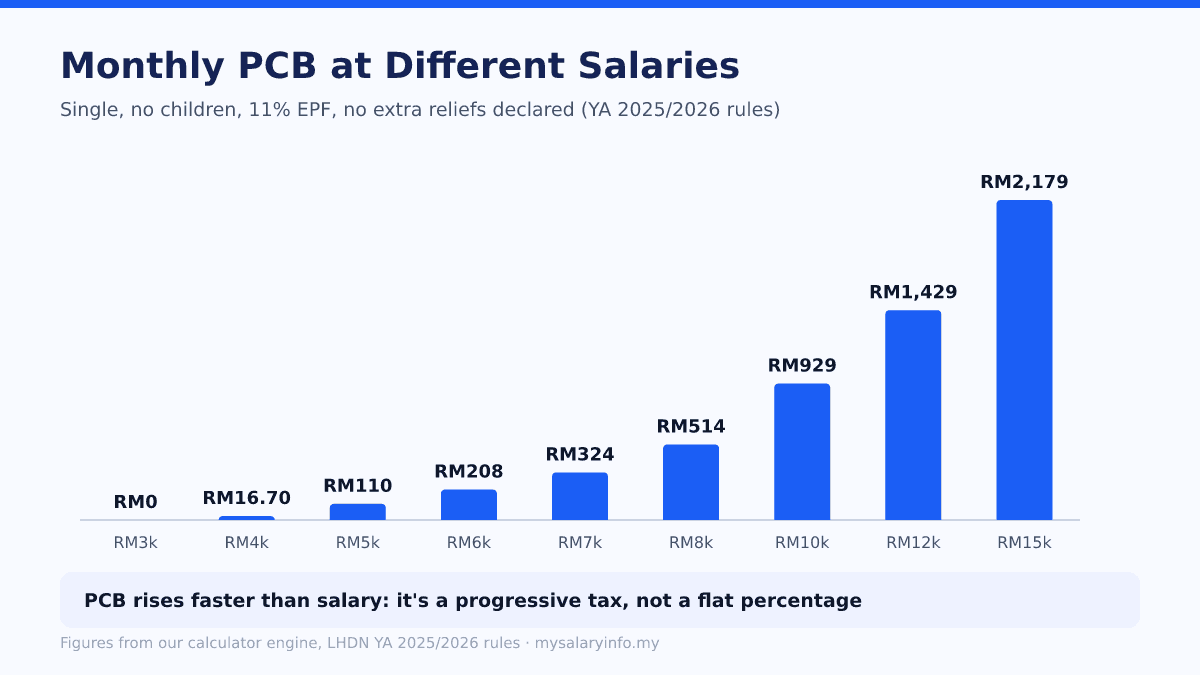
For a single person with no children, standard 11% EPF and no other declared reliefs, our calculator (which uses the same method) gives:
- RM3,000 a month: PCB is RM0. After reliefs, the estimated tax is too small to deduct. Take-home is about RM2,649 after EPF, SOCSO and EIS.
- RM5,000 a month: PCB is about RM110. Take-home is about RM4,305.
- RM8,000 a month: PCB is about RM514. Take-home is about RM6,564.
Family matters too. At RM5,000 a month, a married person whose spouse has no income, with two children, pays about RM70 instead of RM110.
Check your own salary in the PCB calculator. If your payslip is far off, the usual reason is reliefs, allowances or benefits your employer has or hasn't included.
Why your PCB changes during the year
PCB isn't a fixed percentage, so it moves when your situation changes:
- A raise or promotion: higher projected income, and part of it may fall into a higher band.
- Declaring reliefs on Form TP1: insurance premiums, lifestyle purchases, medical costs and similar. Your PCB drops from the next payroll run.
- Changing jobs mid-year: give your new employer Form TP3 with your income and PCB from the previous job. Without it, the new employer calculates as if you'd earned nothing earlier in the year, and you'll likely owe tax at filing.
- Marriage or a new child: once HR updates your details.
- CP38 notice: if LHDN finds you underpaid in an earlier year, it can tell your employer to deduct an extra fixed amount for several months.
What you can declare on TP1
Form TP1 lets you tell your employer about reliefs so your PCB reflects them during the year. Common items:
- Life insurance and EPF (above what's already deducted), up to the usual caps
- Medical and education insurance premiums
- Lifestyle purchases (books, devices, internet, courses) and sports spending
- Medical expenses for yourself, your spouse, your children or your parents
- SSPN deposits, childcare fees, education fees and zakat
You can submit TP1 more than once a year, and your employer applies it from the next payroll run. Keep the receipts, because the same claims will go into your e-Filing.
Part-time work and second jobs
If you have two employers at once, each one deducts PCB as if it were your only job. Neither knows about the other, so each applies your personal reliefs and lower tax bands separately. You'll usually be under-deducted overall and owe a balance when you file. Setting aside some of the second salary each month avoids a surprise.
Part-timers and contract staff paid through payroll have PCB worked out the same way as full-time staff, based on what they're paid in the month.
Why the bonus month looks so bad
In the month your bonus is paid, PCB jumps. Here's why.
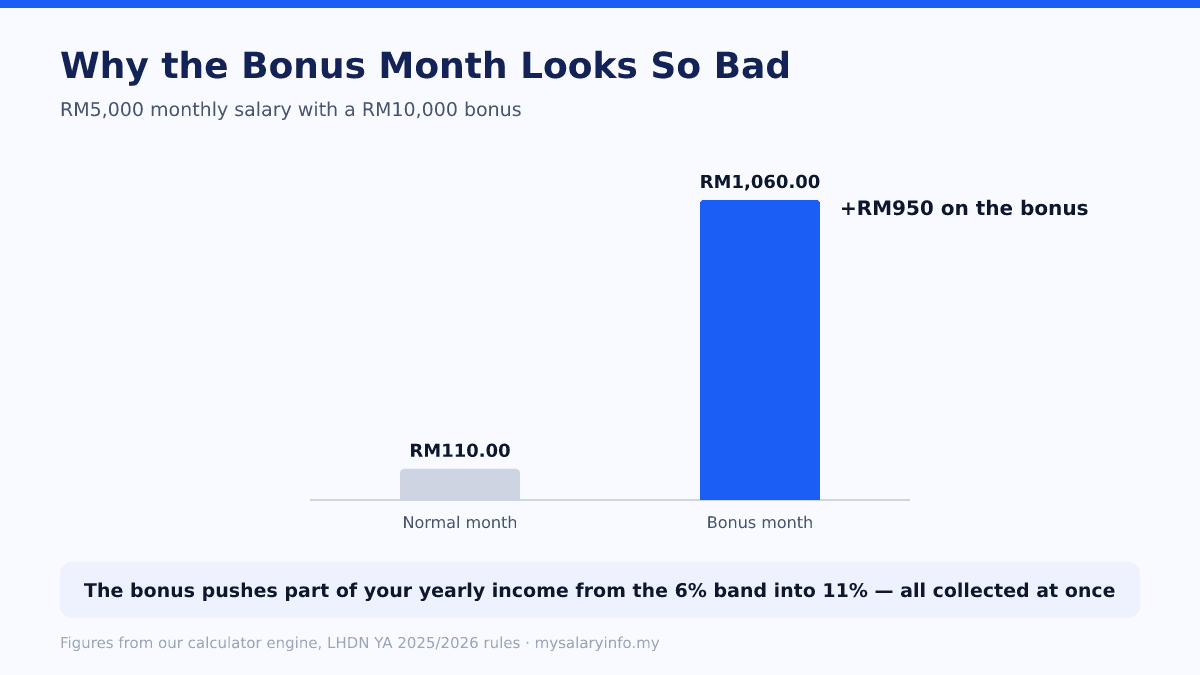
Your employer works out the tax on your yearly income with the bonus and without it, and deducts the whole difference that month. At RM5,000 a month, a RM10,000 bonus adds about RM950 of PCB in the bonus month, so that month's PCB is around RM1,060 instead of RM110.
The bonus isn't taxed at a special rate. It pushes part of your yearly income from the 6% band into the 11% band, and all of the extra tax is collected in one go.
Getting back tax you overpaid
PCB is an estimate. Your actual tax is settled when you file on e-Filing, where you claim every relief, including ones your employer never knew about.
If the PCB taken during the year was more than your final tax, which is common if you claim lifestyle, medical, insurance or SSPN reliefs you didn't declare on TP1, LHDN refunds the difference to the bank account on your MyTax profile. Filing early generally means an earlier refund.
If PCB was too low, for example because of side income, you pay the balance.
There's also a rule that lets employees whose PCB was deducted all year, with no other income, treat PCB as their final tax and skip filing. But if you do that, you can't claim reliefs you didn't declare to your employer, and you give up any refund. For most people, filing is worth the few minutes.
Reading your EA form
By the end of February, your employer must give you an EA form (Borang EA) for the previous year. It shows your total salary, bonus, allowances, benefits in kind, EPF, SOCSO and EIS, and the PCB deducted.
When you file, the employment income and PCB figures in e-Filing should match your EA form. If the PCB on the EA form doesn't match your payslips, ask HR before you file. A mismatch usually means a payroll error that's easier to fix before LHDN processes your return.
Quick checklist
- Declare your reliefs on TP1 so less is deducted during the year.
- Give your new employer TP3 if you change jobs.
- Check your EA form in February against your payslips.
- File on time. It's the only way to get a refund.
Check the official sources
Check the applicable assessment year and eligibility conditions. Calculator estimates do not replace the official schedules or guidance.