
Resident vs Non-Resident Tax in Malaysia: How the 182-Day Rule Works
Your residence status, not your nationality, decides whether you pay 0–30% progressive rates with reliefs or a flat 30%. Here's how the 182-day rule and its alternatives work, with a side-by-side example.
By My Salary Info · 6 min read
Last updated: 25 September 2026
In Malaysia, how much income tax you pay depends heavily on one question: are you a tax resident for the year? It has nothing to do with citizenship or visa type. A Malaysian working in Singapore can be a non-resident here, and a foreigner on an employment pass can be a resident. What counts is how many days you were physically in Malaysia.
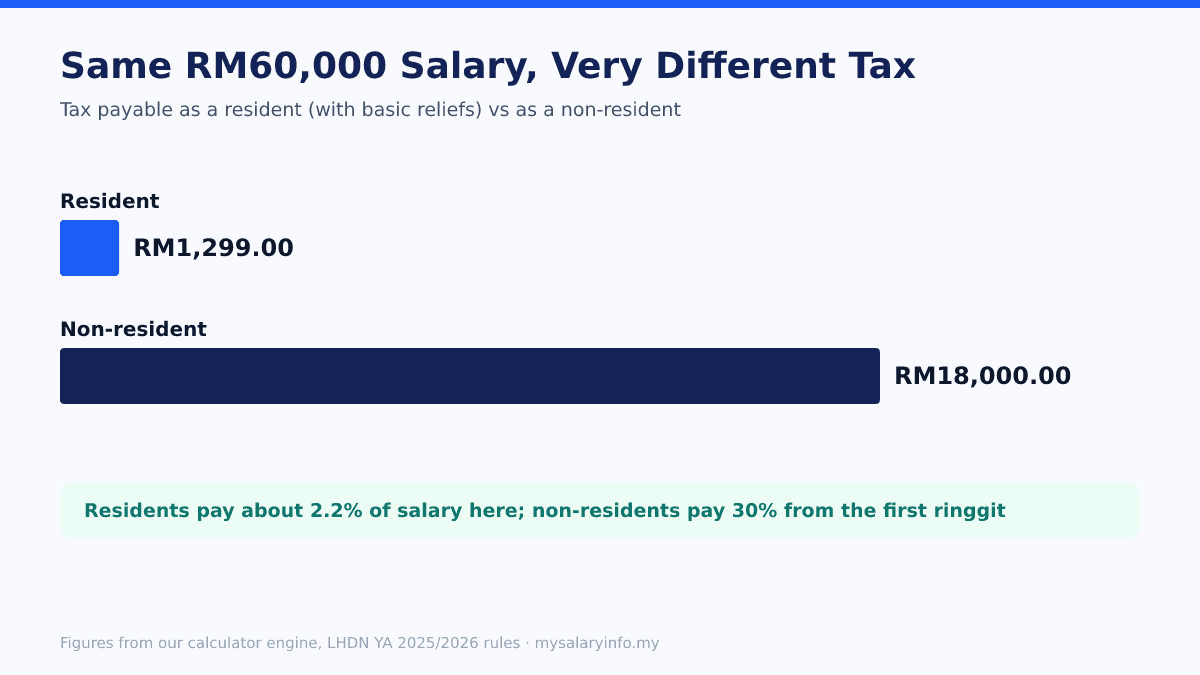
The difference is large. On a RM60,000 income, a resident with basic reliefs pays around RM1,299. A non-resident pays RM18,000.
Key points
- Residence depends on days physically in Malaysia, not on citizenship or visa type.
- 182 days in a calendar year makes you resident. Three other tests under Section 7 can too.
- Residents pay 0–30% progressive rates with reliefs and rebates. Non-residents pay a flat 30% with none.
- On RM60,000 of salary, that's about RM1,299 as a resident versus RM18,000 as a non-resident.
- If you qualify as resident, it applies to the whole year, and any excess PCB is refunded after you file.
The 182-day rule
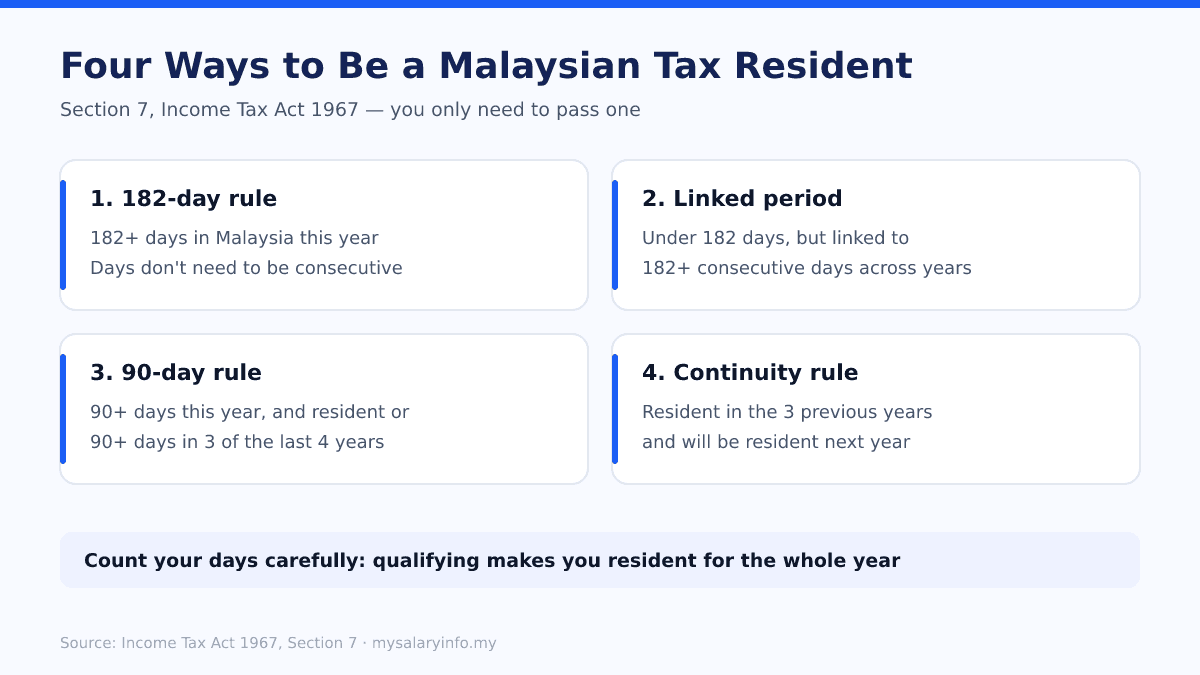
Under Section 7 of the Income Tax Act 1967, the usual way to become resident is to be in Malaysia for 182 days or more in a calendar year. The days don't have to be consecutive, and part of a day generally counts as a full day.
If you fall short, there are three other ways to qualify:
- Linked period: you were here fewer than 182 days this year, but that period is linked to 182 or more consecutive days that run into the previous or next year. Short absences for business trips, medical treatment or social visits of up to 14 days don't break the chain.
- 90-day rule: you were here at least 90 days this year, and in three of the previous four years you were either resident or here at least 90 days.
- Continuity rule: you were resident in each of the three previous years and will be resident next year, even if you spent little or no time in Malaysia this year.
What residents get
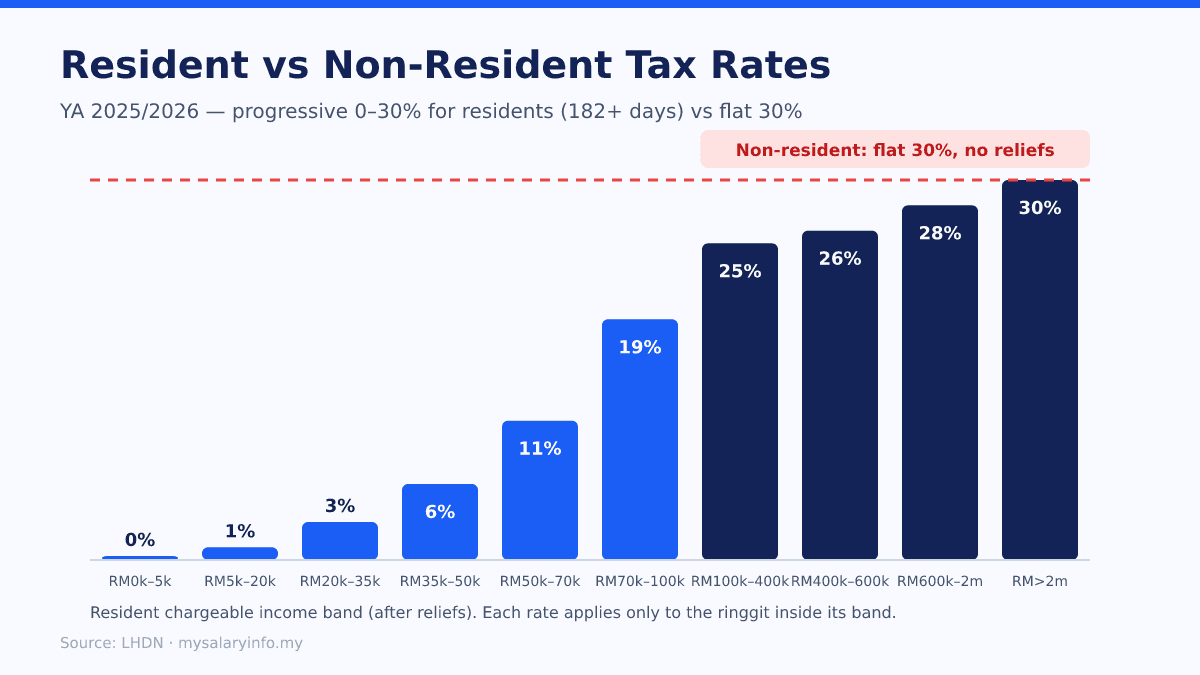
Residents are taxed on a progressive scale from 0% to 30%. The first RM5,000 of chargeable income is tax-free, the next RM15,000 is taxed at 1%, and so on up. Each rate only applies to the slice of income inside its band.
Residents can also claim:
- the automatic RM9,000 individual relief, plus EPF, insurance, lifestyle, medical, education, child and spouse reliefs
- the RM400 rebate when chargeable income is RM35,000 or less
- a ringgit-for-ringgit zakat rebate
What non-residents pay
Non-residents pay a flat 30% on employment and business income from Malaysia, starting from the first ringgit. There's no tax-free band, no personal reliefs and no rebates.
Some special cases:
- Short-term employment: if you work in Malaysia for 60 days or less in the year, that employment income is exempt. This doesn't apply to directors' fees or public entertainers.
- Withholding tax: some income has its own rate, for example royalties at 10% and interest at 15%.
- Tax treaties: Malaysia has double taxation agreements with many countries that can cut these rates or exempt the income. Check the treaty with your home country.
Common situations
Malaysians working in Singapore. If you commute across the Causeway every day, you're physically in Malaysia part of each day, so you'll usually pass 182 days and be a Malaysian tax resident. Your Singapore salary is foreign-sourced, and foreign-sourced income received by resident individuals in Malaysia is currently exempt, subject to conditions. If you actually live in Singapore and only visit on weekends, you'll likely be a non-resident here.
Expats arriving mid-year. Someone who starts work in Malaysia in September won't reach 182 days that year. But if they stay on into the next year, the linked-period rule can make them resident for both years. Keep track of your dates and ask your employer's HR or tax adviser before assuming the flat 30% applies.
Returning Malaysians. If you've been working abroad and move home, you become resident again once you pass one of the tests. Approved returning experts under TalentCorp's Returning Expert Programme may qualify for a flat 15% rate on employment income for a set period. Check the current terms with TalentCorp before counting on it.
Side-by-side: RM60,000 a year
Take someone earning RM60,000 in salary.
As a resident: reliefs of RM9,000 (individual), RM4,000 (EPF) and RM350 (SOCSO/EIS) leave chargeable income of RM46,650. Tax is RM600 on the first RM35,000 plus 6% on the remaining RM11,650, so RM1,299 in total. That's an effective rate of about 2.2%.
As a non-resident: 30% of RM60,000 is RM18,000.
That RM16,700 gap is why it's worth counting your days carefully if you arrive or leave partway through the year.
If you arrived or left mid-year
Employers often deduct PCB at the non-resident rate until they're sure you'll pass 182 days. If you do end up qualifying, including through a linked period, you're treated as resident for the whole year, and the extra tax you paid comes back as a refund after you file.
Keep your own record of entry and exit dates. Passport stamps and flight bookings are what LHDN will look at if your status is questioned.
The yearly calculator has both resident and non-resident modes, so you can compare the two outcomes with your own numbers.
Keep a simple travel log
If your residence could be questioned, keep a record as you go rather than piecing it together at filing time:
- the dates you entered and left Malaysia each time
- the reason for any absence (business trip, medical, family visit)
- copies of your passport stamps or MyTravel records, flight bookings and your employment contract
A spreadsheet with one row per trip is enough. It makes counting to 182 days straightforward, and it's the evidence LHDN will ask for if your status is ever reviewed.
Questions people often ask
Does my nationality matter? No. Residence for tax is based only on days in Malaysia and the Section 7 tests. Citizenship, PR status and visa type don't decide it.
Can I be resident in two countries at once? Yes, it happens. Tax treaties have "tie-breaker" rules that decide which country gets the main right to tax you. If you need to prove Malaysian residence to another country, you can apply to LHDN for a certificate of residence.
My employer deducted PCB at 30%. Is that final? No. PCB is a prepayment. If you end up resident for the year, your real tax is worked out on e-Filing with resident rates and reliefs, and the excess is refunded.
Which form do you file?
- Residents with employment income only file Form BE (due 30 April). Residents with business income file Form B (due 30 June).
- Non-residents file Form M (due 30 April, or 30 June if they have business income).
If a foreign employee is leaving Malaysia for good, the employer has to notify LHDN on Form CP21 at least a month before departure and hold back the final salary payment until LHDN confirms the tax position. That's why expats are often asked to settle their taxes before their last payday.
Check the official sources
Check the applicable assessment year and eligibility conditions. Calculator estimates do not replace the official schedules or guidance.