
Malaysia Tax Reliefs for YA 2025 and 2026: What You Can Claim (and What People Miss)
A plain-English run-through of the personal reliefs for YA 2025 and 2026, including the Budget 2026 changes, what each one covers, and a worked example showing how much they actually save.
By My Salary Info · 7 min read
Last updated: 8 October 2026
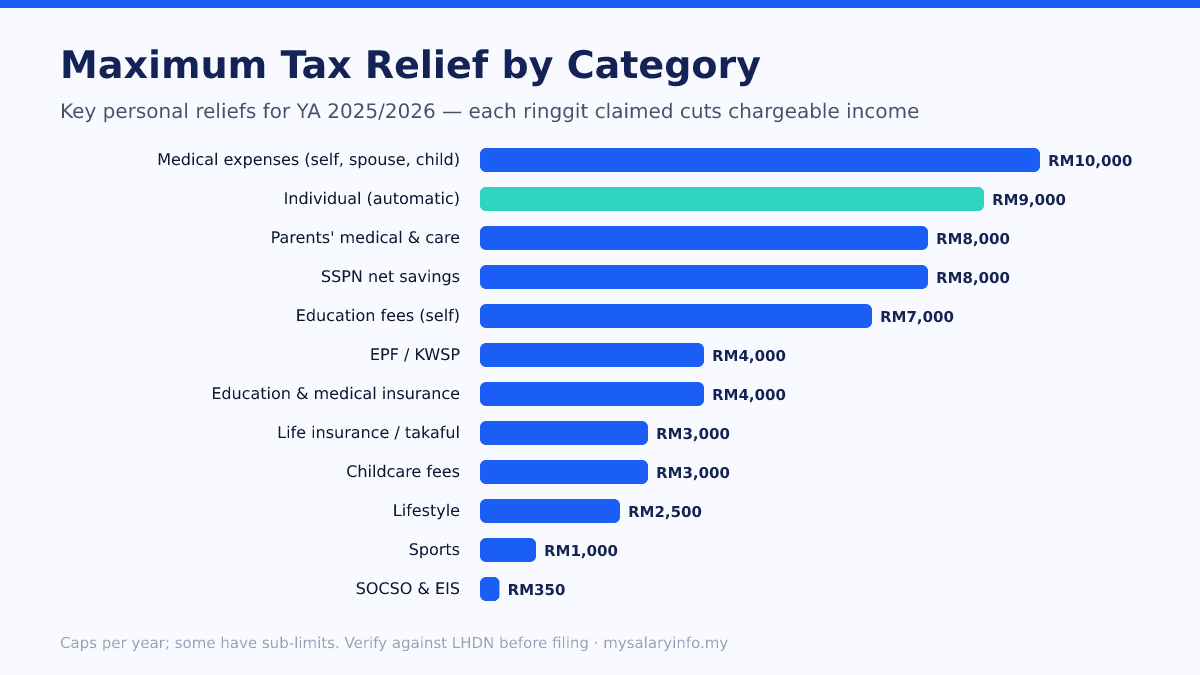
Tax reliefs are the main way to legally pay less income tax in Malaysia. Every ringgit of relief comes off your chargeable income, the figure LHDN runs through the tax brackets. The catch is that you have to claim them yourself on e-Filing, and a lot of people leave money on the table because they don't know what counts.
This guide goes through the reliefs most working Malaysians can use for YA 2025 (the return you file in 2026) and YA 2026 (filed in 2027), flags what Budget 2026 changed, and ends with a worked example.
Key points
- Every tax resident gets RM9,000 of relief automatically, and a RM400 rebate if chargeable income is RM35,000 or less.
- Mandatory EPF can fill the RM4,000 category, while qualifying additional voluntary EPF may still use unused capacity in the separate RM3,000 life insurance / voluntary EPF category. Do not double-claim.
- Lifestyle (RM2,500) and sports (RM1,000) reliefs cover things many people buy anyway, like a phone, broadband and a gym membership.
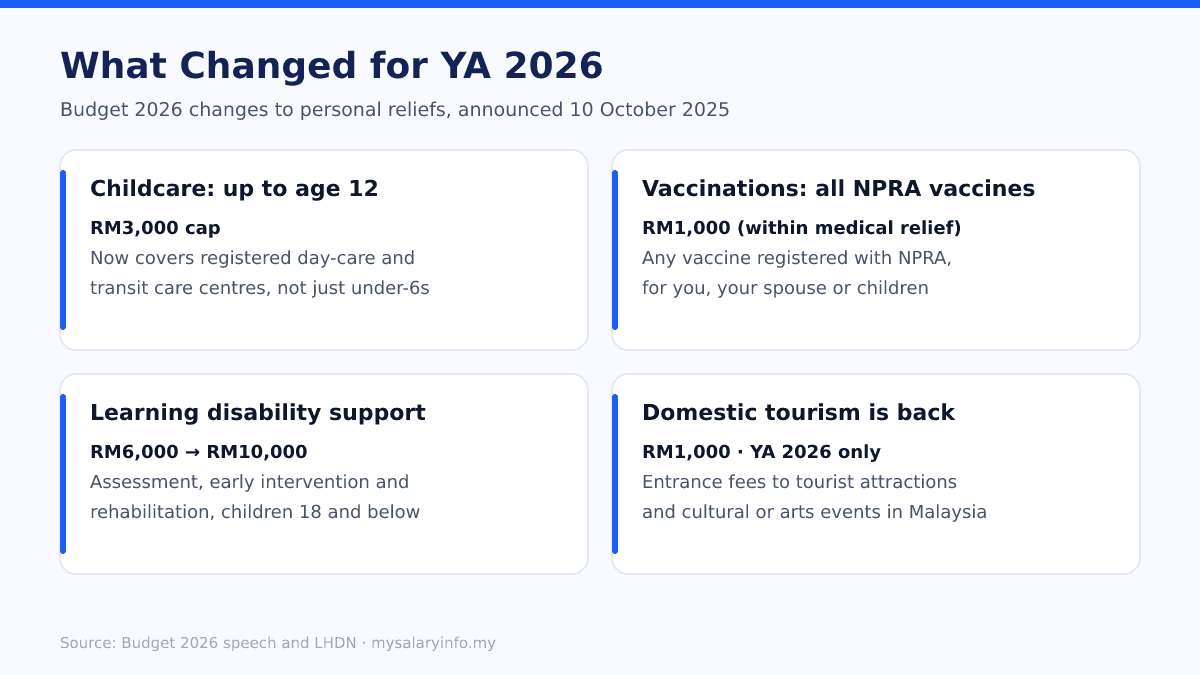
- Budget 2026 widened childcare relief to children up to 12, covered every NPRA-registered vaccine and brought back RM1,000 domestic tourism relief for YA 2026.
- A relief is worth your top tax rate times the amount. Claim what you spend, but don't spend just to claim.
What you get without doing anything
Every tax resident gets the RM9,000 individual relief automatically. There's nothing to claim or prove.
A few more depend on your family:
- Spouse with no income (or who elects joint assessment): RM4,000
- Each unmarried child under 18: RM2,000
- Child aged 18 or over in full-time higher education: RM8,000 (diploma level and above in Malaysia, or degree level and above overseas)
- Disabled child: RM8,000, or RM16,000 if they're also in higher education
Then there's the RM400 rebate. It isn't a relief. It comes off your tax bill directly, and it applies when your chargeable income is RM35,000 or less. For someone earning RM42,000 a year with just the automatic reliefs, chargeable income comes to RM28,650 and the tax works out to RM409.50. The rebate brings that down to RM9.50.
EPF and life insurance are two separate limits
For YA 2025, HASiL lists two separate limits:
- Up to RM4,000: mandatory contributions to approved schemes or voluntary EPF contributions.
- Up to RM3,000: life insurance premiums, family takaful or additional voluntary EPF contributions.
At an 11% contribution rate for 12 months, mandatory EPF reaches RM4,000 at a monthly salary of about RM3,030. That uses the first category, but qualifying voluntary top-ups may still use unused capacity in the second category. Do not claim the same contribution twice.
For example, if mandatory EPF already uses the RM4,000 category and you have RM1,000 of eligible life insurance premiums, up to RM2,000 of qualifying additional voluntary EPF could fill the remaining RM3,000 category. A deduction only saves tax where there is tax to reduce.
In the yearly calculator, enter the allocated amounts in the EPF field and the life insurance / additional voluntary EPF field. Check the applicable year and conditions in HASiL's tax relief schedule.
Lifestyle: RM2,500, plus RM1,000 for sports
The lifestyle relief of up to RM2,500 covers things most people buy anyway, for yourself, your spouse or your children:
- Books, magazines and newspapers (printed or digital)
- A computer, smartphone or tablet (not bought for business use)
- Your monthly internet bill, if it's registered in your name
- Skills or self-improvement courses
Sports have their own RM1,000 relief on top of that: sports equipment, gym memberships, facility rental, competition entry fees and training fees. A gym membership and a broadband plan alone can take RM3,500 off your chargeable income.
Medical and insurance
Medical expenses for yourself, your spouse or your child: up to RM10,000. This covers treatment for serious diseases and fertility treatment, and it has smaller limits inside it:
- Full medical check-ups, mental health consultations and some self-test kits: up to RM1,000 combined
- Vaccinations: up to RM1,000. From YA 2026 this covers any vaccine registered with the NPRA, not just a short list.
- Dental treatment: up to RM1,000
- Assessment, early intervention and rehabilitation for a child with a learning disability: raised to RM10,000 from YA 2026, for children aged 18 and below
Parents' medical care: up to RM8,000. This covers treatment, special needs and carer costs for your parents, including a check-up sub-limit of RM1,000.
Education and medical insurance: up to RM4,000. Premiums for medical cards, hospitalisation, critical illness and education policies count, for policies covering you, your spouse or your children.
Family, savings and your first home
- SSPN: up to RM8,000 on your *net* deposits for the year, meaning deposits minus any withdrawals you made in the same year.
- Childcare fees: up to RM3,000. From YA 2026 this covers registered day-care and transit care centres for children up to age 12, not just kindergartens for under-6s.
- Breastfeeding equipment: up to RM1,000, claimable once every two years.
- Housing loan interest on your first home: up to RM7,000 a year for homes up to RM500,000, or RM5,000 for homes between RM500,000 and RM750,000. It applies to sale and purchase agreements signed from 2025 to 2027, for the first three years of the loan.
- EV charging and food-waste composting equipment: up to RM2,500.
New for YA 2026
In short, Budget 2026:
- widened childcare relief to children up to 12 at registered day-care and transit care centres
- extended vaccination relief to every NPRA-registered vaccine
- raised the child learning-disability sub-limit from RM6,000 to RM10,000
- brought back domestic tourism relief of up to RM1,000, for YA 2026 only, covering entrance fees to tourist attractions and cultural or arts events in Malaysia
You may see posts online about a "home office equipment relief" or a separate "digital learning relief" for YA 2026. We haven't found either in the Budget 2026 documents. Treat claims like that with caution until LHDN publishes them.
Worked example: how much do reliefs actually save?
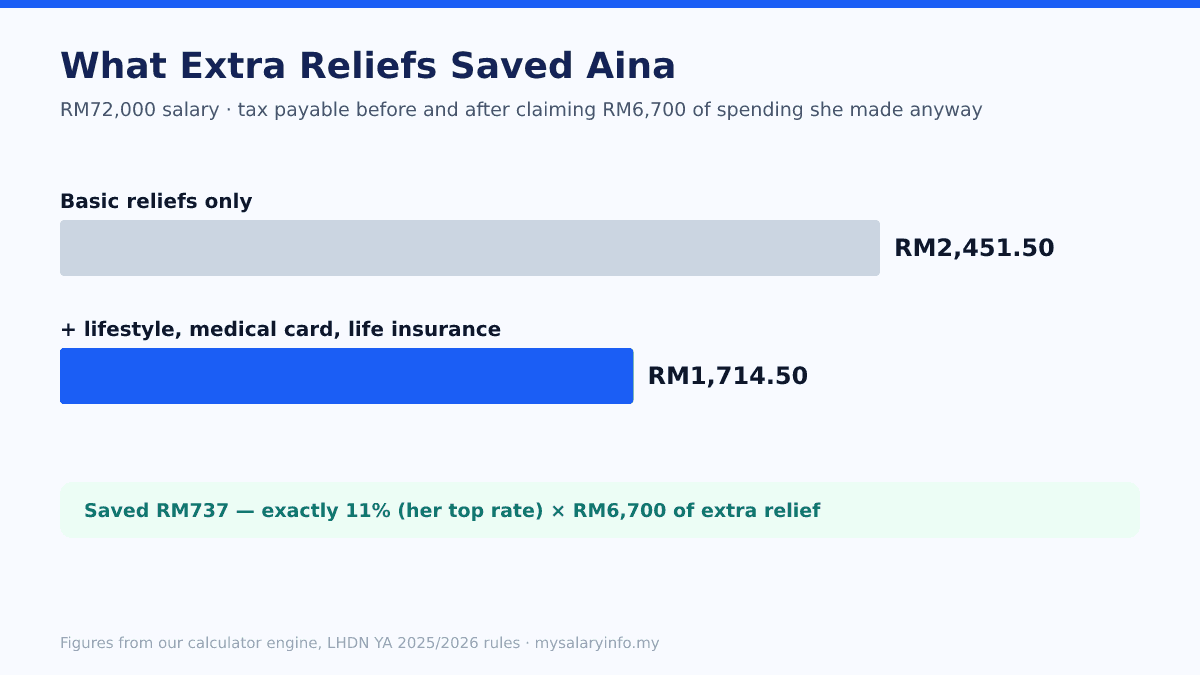
Aina earns RM6,000 a month, RM72,000 a year. With only the automatic and statutory reliefs (RM9,000 individual, RM4,000 EPF and RM350 for SOCSO/EIS), her chargeable income is RM58,650 and her tax is RM2,451.50.
Now say she also claims things she paid for anyway:
- RM2,500 lifestyle (new phone plus a year of home broadband)
- RM2,400 for her medical card
- RM1,800 in life insurance premiums
That's RM6,700 of extra relief. Her chargeable income drops to RM51,950 and her tax falls to RM1,714.50, a saving of RM737.
Notice that the saving is exactly 11% of RM6,700. That's her marginal rate. A relief is only worth your top tax rate times the amount, so spending RM1,000 you didn't need to spend, just to claim it, saves you RM110 at best. Claim what you'd buy anyway. Don't shop for reliefs.
Claiming without trouble
- Keep receipts for seven years. LHDN can ask for proof of any claim. Photos or PDFs are fine if they're readable and organised by year.
- Claim in the year you paid. The payment date decides the year, not when the item arrived or the course started.
- Make sure receipts are in your name. Where the relief covers family members, keep proof of the relationship too.
- Don't double-claim with your spouse. If you file separately, each receipt can only be claimed once.
To see what your own reliefs are worth, enter them in the yearly calculator. It applies every cap automatically.
Check the official sources
Check the applicable assessment year and eligibility conditions. Calculator estimates do not replace the official schedules or guidance.