
Side Income and Freelance Tax in Malaysia: Form B, SSM and What You Can Deduct
Freelancing, e-hailing or selling online on top of your job? When you need Form B instead of Form BE, whether to register with SSM, which expenses you can deduct, and how side income changes your tax.
By My Salary Info · 7 min read
Last updated: 25 September 2026
Plenty of people in Malaysia earn something outside their main job: design work on weekends, e-hailing after hours, tuition, an online shop, content creation. The tax rules for side income aren't complicated, but one of them is strict: every ringgit has to be declared.
This guide covers which form to file, when you need to register with SSM, what you can deduct, and what side income does to your tax bill.
Key points
- All side income must be declared, however small. There's no tax-free minimum.
- If you have business or freelance income, file Form B (due 30 June), not Form BE.
- Rental income on its own is usually non-business income and still goes on Form BE.
- Genuine business expenses can be deducted with no fixed cap, but shared costs must be split fairly.
- Side income can push you past RM35,000 of chargeable income and cost you the RM400 rebate, so estimate early.
There's no minimum amount
There's no threshold below which side income is tax-free. RM300 from one freelance job and RM30,000 from a year of e-hailing both have to be declared. The side income is added to your salary, and the total goes through the same tax brackets.
You won't always owe extra, because your reliefs and the lower bands may absorb it. You still have to report it. LHDN now gets data from platforms, payment providers and e-invoicing records, and undeclared income found later comes with penalties on top of the tax.
If you've never filed before
If you've never had a tax file, register as a taxpayer first through e-Daftar on the MyTax portal. You'll need your MyKad and, if you have one, your SSM registration details. Once LHDN issues your tax identification number (TIN), you can activate e-Filing and file Form B.
Salaried employees usually already have a tax file through their employer. In that case you just switch to filing Form B instead of BE.
Form BE or Form B?
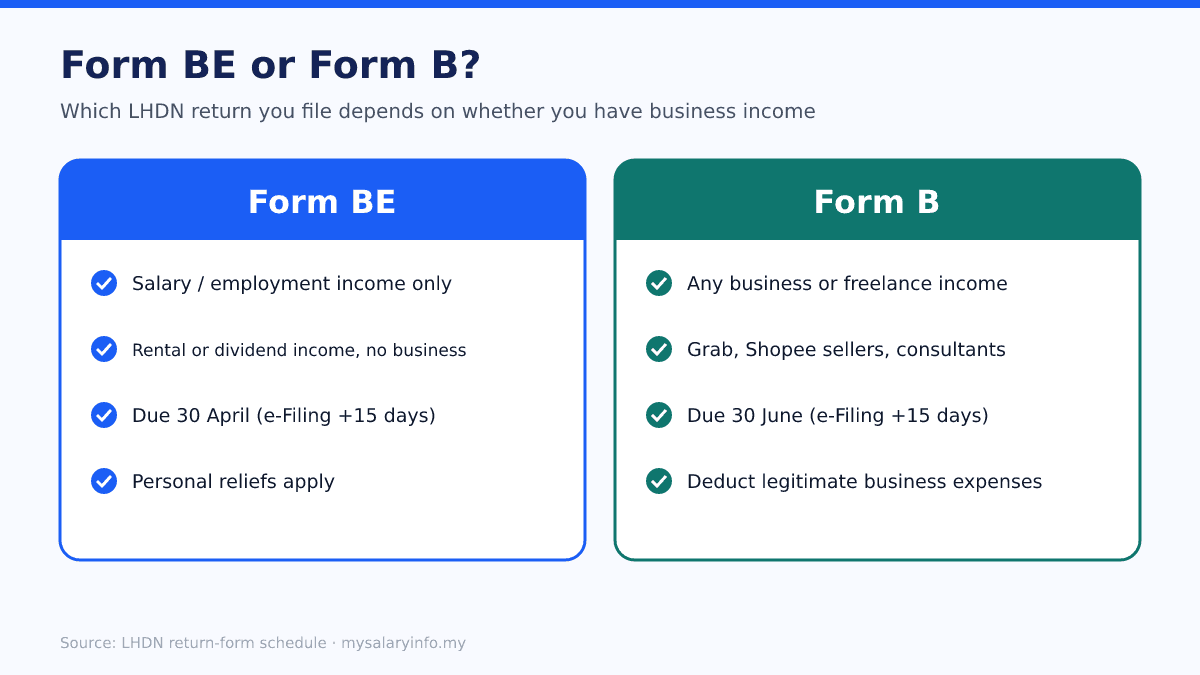
- Form BE is for people whose only income is employment: salary, bonus, allowances, benefits. It's due 30 April, with e-Filing usually allowed until 15 May.
- Form B is for people with business income, meaning income from a trade, profession or vocation you run yourself. It's due 30 June, with e-Filing usually allowed until 15 July.
If you have a salary *and* freelance or business income, you file Form B, and your salary goes on the same form.
A one-off sale of your own belongings isn't a business. Regular, repeated work for income is: an e-hailing driver working most weekends, a freelancer with repeat clients, a seller restocking an online shop. That's what moves you onto Form B.
Rental income is a special case
Renting out a property is usually treated as non-business income. If your only extra income is rent, you normally still file Form BE, declaring the rent after deducting allowable expenses like assessment, quit rent, fire insurance, repairs and interest on the property loan.
Rental only counts as business income if you provide substantial services alongside it, for example running serviced apartments with cleaning, maintenance and guest management. In that case it goes on Form B.
How side income changes your tax: an example
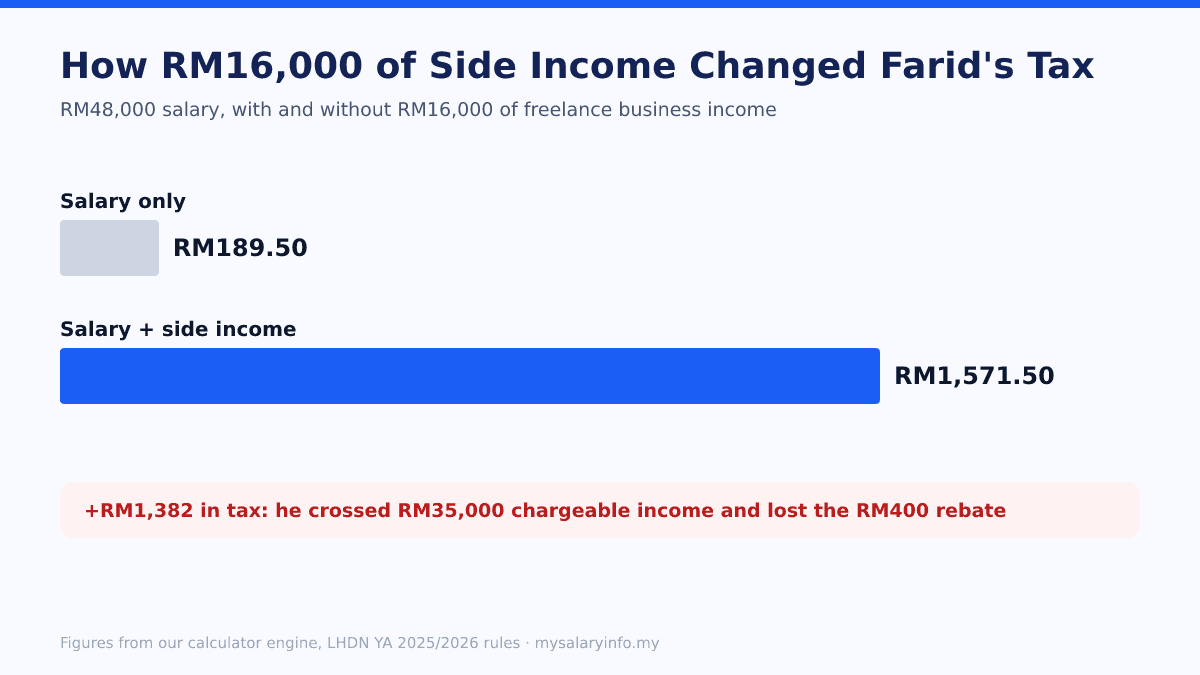
Farid earns RM48,000 a year in salary. With the RM9,000 individual relief, RM4,000 EPF and RM350 SOCSO/EIS, his chargeable income is RM34,650. That's under RM35,000, so he gets the RM400 rebate and his tax is just RM189.50.
He also freelances, bringing in RM20,000 of revenue with RM4,000 of expenses, so RM16,000 of business income. His chargeable income rises to RM50,650. He loses the RM400 rebate and part of his income now falls in the 11% band. His tax becomes RM1,571.50.
The side income itself was only RM16,000, but his tax went up by almost RM1,400. Crossing the RM35,000 line and losing the rebate is what does it. It's worth estimating this early in the year so the bill isn't a surprise.
Do you need to register with SSM?
Under the Registration of Businesses Act 1956, anyone carrying on a business in Malaysia, including as a sole proprietor, generally has to register with the Companies Commission of Malaysia (SSM). That applies once your side activity is a real, ongoing business: regular clients, an online shop you keep running, a tuition class with fixed students.
Registration doesn't change your tax. LHDN taxes income whether or not you're registered. But running a business without registering can lead to separate penalties under the Act. Registering a sole proprietorship with SSM is inexpensive and can be done online through the EzBiz portal.
What expenses can you deduct?
Business income is taxed after expenses. Unlike personal reliefs, these aren't capped, but they must be wholly and exclusively incurred to earn the income. Common examples:
- Software and subscriptions you use for the work (design tools, hosting, accounting apps)
- The business share of your phone and internet bills
- Fuel, tolls and parking for e-hailing or delivery work
- Platform commissions and payment gateway fees
- Advertising, professional fees and business insurance
- Materials or stock for the things you sell
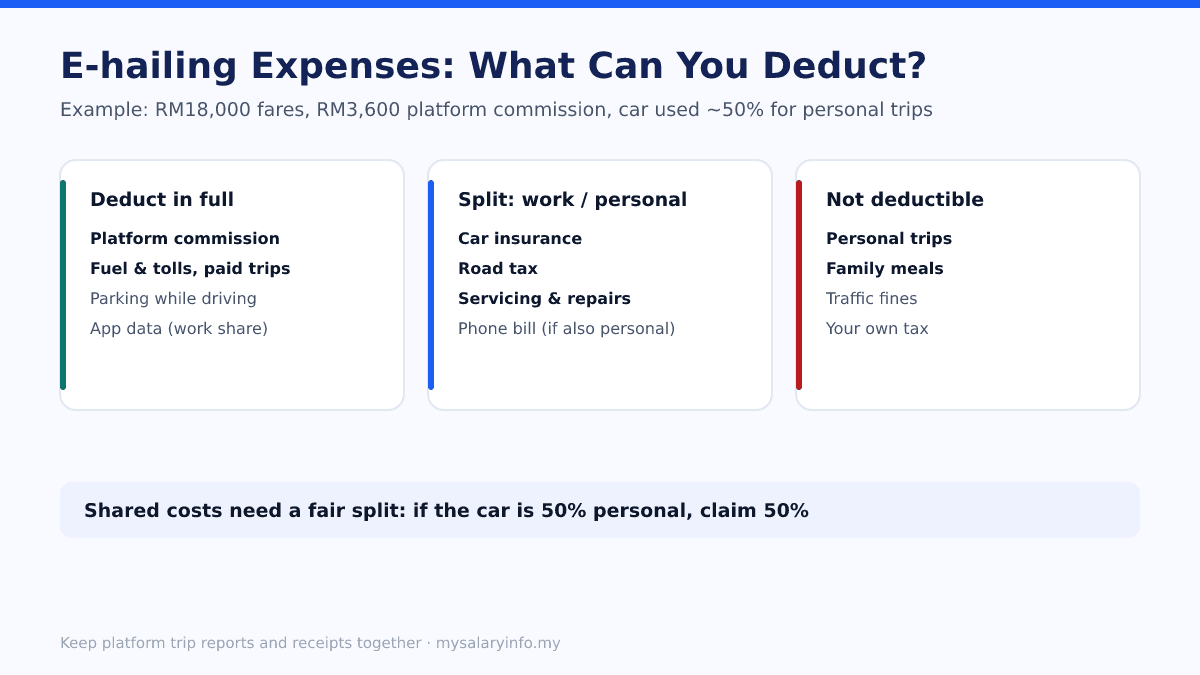
Shared costs need a fair split. If your phone is used half for work, claim half. Keep receipts and a simple record of income and expenses as you go. A spreadsheet updated once a month is much easier than rebuilding a year from bank statements in June.
Example: an e-hailing driver's expenses
Say you drive e-hailing part-time and earn RM18,000 in fares for the year. The platform takes RM3,600 in commission. You spend RM4,200 on fuel and tolls while driving, and your car is also used for personal trips about half the time.
You can deduct the full RM3,600 commission, because it only relates to the business. Fuel and tolls from your trip logs can be claimed for the driving you did for fares. Costs like insurance, road tax and maintenance need to be split fairly between business and personal use. Keeping the platform's trip reports and your own fuel receipts together makes this easy to justify if LHDN asks.
Common mistakes to avoid
- Filing Form BE out of habit after starting a business. Once you have business income, it's Form B.
- Declaring only what the platform reports. Cash jobs, bank transfers and tips count too.
- Claiming personal spending as expenses. Family meals and personal phone use don't become business costs because you sometimes talk about work.
- Forgetting the deadline is later. Form B is due on 30 June, not 30 April, but leaving it to the last week makes mistakes more likely.
Staying on LHDN's good side
- Declare everything, even if you expect to owe nothing.
- Keep records monthly: income in, expenses out, receipts saved.
- Register with SSM once it's a real business.
- Watch for a CP500. If you have business income, LHDN may send you a CP500 schedule asking you to pay tax in instalments during the year. Pay those on time.
- Put money aside. No one is deducting PCB from your side income, so set aside 10–20% of it for tax.
Once you know your salary and business income, enter both in the yearly calculator to estimate your total tax.
Check the official sources
Check the applicable assessment year and eligibility conditions. Calculator estimates do not replace the official schedules or guidance.