
Comparing Job Offers in Malaysia: Look at Total Compensation, Not Just Salary
A higher basic salary doesn't always mean a better offer. How to add up bonus, employer EPF, equity and benefits, how each is taxed in Malaysia, and what to ask before you sign.
By My Salary Info · 6 min read
Last updated: 25 September 2026
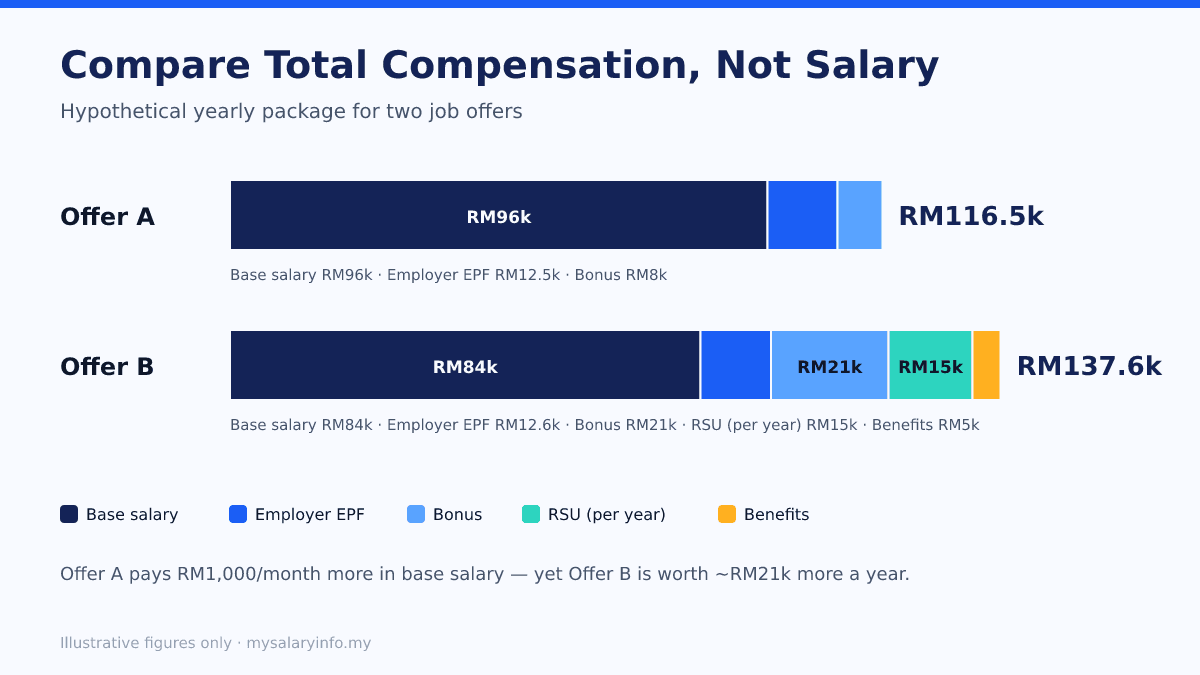
When two job offers land at the same time, it's natural to compare the basic salary and pick the bigger number. But a Malaysian pay package is more than the monthly figure: bonus months, the employer's EPF share, medical cover, allowances and sometimes shares. Two offers with a RM1,000 difference in basic can easily be RM20,000 apart once you add everything up.
Here's how to compare them properly.
Key points
- Add up basic salary, bonus actually paid, employer EPF, shares and benefits before comparing offers.
- Employer EPF is 13% on wages up to RM5,000 a month and 12% above that, including on bonuses.
- Ask what bonus was actually paid in each of the last three years, not just the target.
- Some allowances are tax-exempt up to set limits, so RM500 of exempt allowance can be worth more than a RM500 raise.
- Get the key terms in writing, including any signing-bonus clawback.
Worked example: Offer A vs Offer B
- Offer A: RM8,000 basic, one month's bonus, standard benefits.
- Offer B: RM7,000 basic, a three-month bonus target, RM15,000 of shares vesting per year and about RM5,000 of extra benefits (better medical cover, a phone allowance).
On basic salary, A wins by RM12,000 a year. Adding it all up:
- Offer A: RM96,000 basic + RM8,000 bonus + about RM12,500 employer EPF = about RM116,500
- Offer B: RM84,000 basic + RM21,000 bonus + about RM12,600 employer EPF + RM15,000 shares + RM5,000 benefits = about RM137,600
B is worth around RM21,000 more a year, provided the bonus and shares are real. The rest of this guide is about checking that.
Basic salary
Your basic salary is the only part that's guaranteed, and a lot hangs off it: your EPF, future increments (usually a percentage of basic) and often your bonus. A higher basic compounds over the years in a way a one-off bonus doesn't.
Ask: "What's the salary range for this role, and what does it take to reach the top of it?"
Bonus
In Malaysia bonuses are usually quoted in months of basic salary. What matters is what was actually paid, not the target.
- Ask what was paid in each of the last three years. A "three-month target" that has paid out one month for three years running is a one-month bonus.
- Check the eligibility date. Many companies only pay if you're still employed, and not serving notice, on the payout date.
- Ask about pro-rating if you're joining partway through the year.
Bonuses are taxed as employment income. Your employer deducts extra PCB in the month the bonus is paid, which is why that payslip can look harsh. You're not taxed at a special rate. The bonus just pushes part of your income into a higher band. The PCB calculator shows the bonus-month deduction.
Employer EPF
Your employer pays EPF on top of your salary: 13% if your monthly wage is RM5,000 or less, 12% if it's above. It also applies to your bonus. Some employers pay more than the statutory rate as a perk, so it's worth asking.
It isn't cash in hand, but it's real money in your retirement account, and it earns EPF dividends.
Signing bonus
A one-off payment when you join, often to make up for a bonus or shares you give up by leaving your current job. It's taxable income in the month you receive it.
Watch for clawbacks. Most signing bonuses have to be repaid in full if you leave within 12 to 24 months, even though you've already paid tax on them.
Ask: "My current employer pays a bonus in March worth about RM X. Can you cover that?"
Shares: RSUs and options
Mostly relevant at multinationals and startups.
- RSUs (restricted share units): shares given to you on a vesting schedule, often over four years. Divide the total grant by the vesting years to get a yearly value, and check whether there's a one-year cliff before anything vests.
- Share options (ESOS): the right to buy shares at a fixed price. They're only worth something if the share price rises above that price and you can actually sell.
In Malaysia, the benefit from shares is generally taxed as employment income when the shares vest or when you exercise your options, even if you haven't sold anything. Set money aside for that.
For private companies, shares may never turn into cash unless the company lists or is sold. Value them cautiously.
Benefits and allowances
Medical and hospitalisation cover, dental, insurance for your family, transport or phone allowances, parking, flexible working and extra leave all have real value. Put a rough ringgit figure on each one.
Some benefits in kind, like a company car, are taxable at LHDN's prescribed values. Others, like group medical cover, generally aren't.
Ask: "Does medical cover start on day one, and does it include my spouse and children?"
Allowances: what's taxed and what isn't
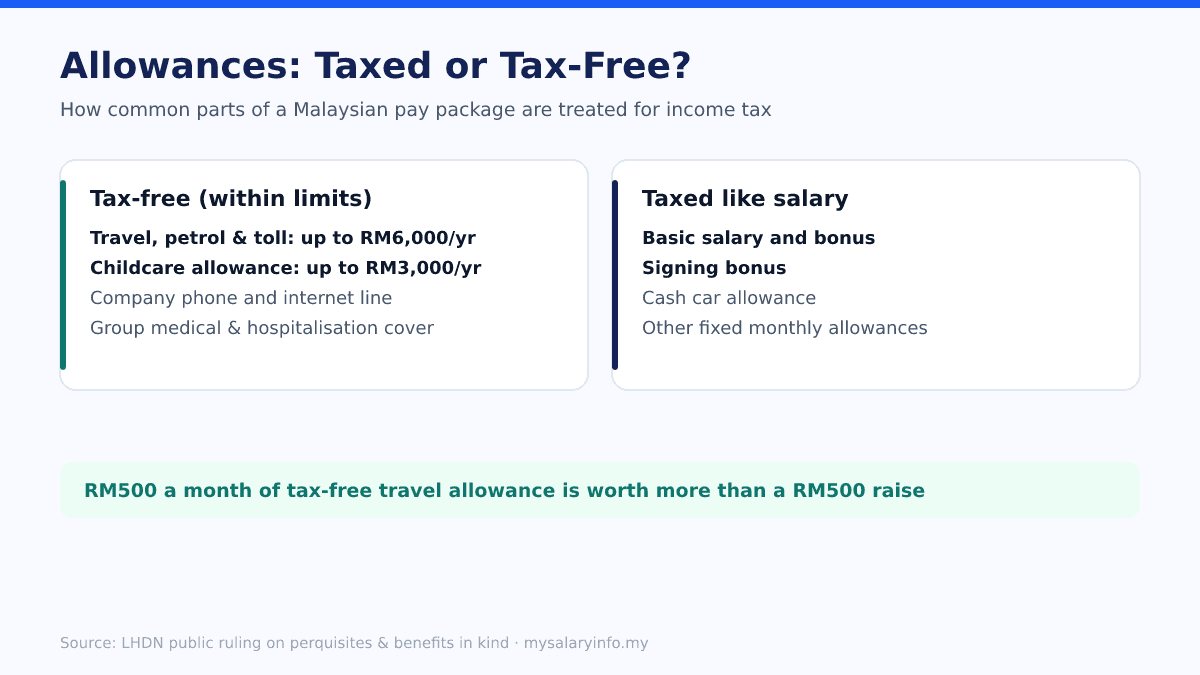
Not every ringgit in an offer is taxed the same way, which matters when you compare packages:
- Travel, petrol and toll allowances for official duties are exempt up to RM6,000 a year. Anything above that is taxable.
- Childcare allowance paid by your employer is exempt up to RM3,000 a year.
- A company phone and internet line provided by your employer are generally tax-free benefits.
- Group medical and hospitalisation cover paid by your employer is generally not taxable to you.
- A cash "car allowance" or fixed monthly allowances outside these categories are taxed like salary.
The exact rules are in LHDN's public ruling on perquisites and benefits in kind. The practical point: RM500 a month in tax-exempt travel allowance is worth more to you than a RM500 raise in basic salary.
Beyond the money
Some things don't show up on a payslip but affect what the job is worth:
- Notice period: a three-month notice period makes your next move slower.
- Probation: some benefits, bonus eligibility or confirmation increments only kick in after probation.
- Leave and flexibility: an extra five days' leave or two days a week working from home saves real time and commuting costs.
- Career path: a slightly lower offer at a company where you'll learn faster can pay off within a couple of years.
Write each one down next to the numbers so you're comparing whole offers, not just salaries.
Before you sign
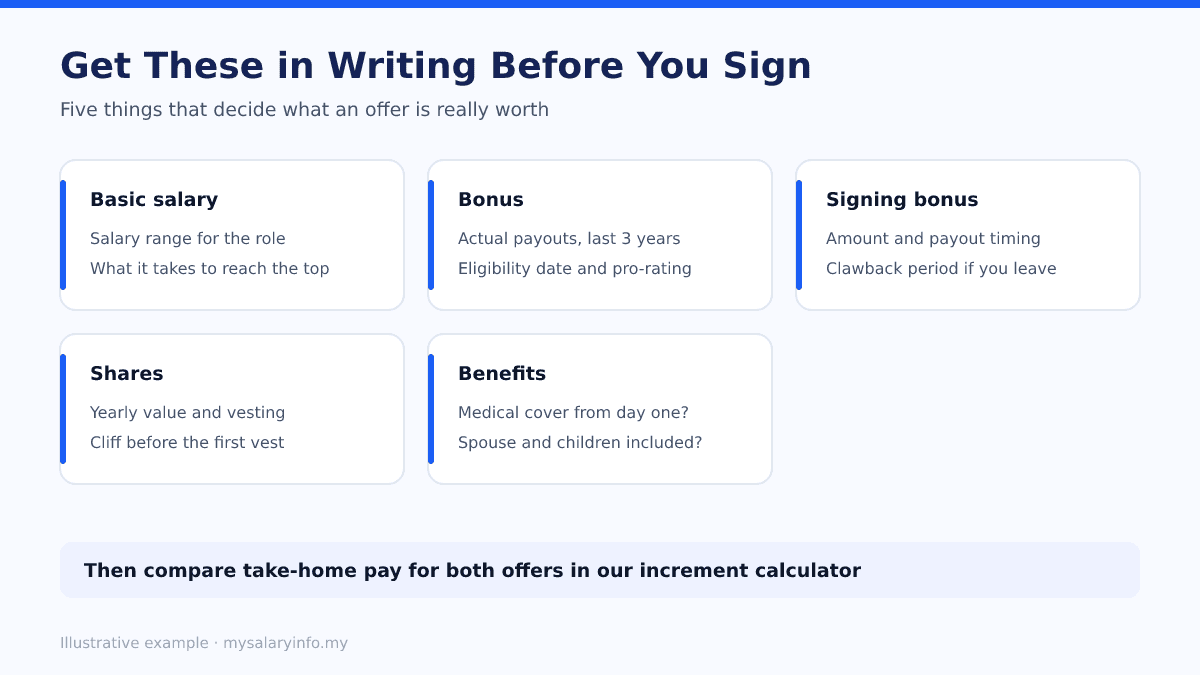
Get the important parts in writing: basic salary, bonus terms, signing bonus and any clawback, share grant and vesting schedule, and the benefits list. Then run both basic salaries through our increment comparator or PCB calculator to see the monthly take-home difference. The gap after tax and EPF is usually smaller than the gap in basic salary.
Check the official sources
Check the applicable assessment year and eligibility conditions. Calculator estimates do not replace the official schedules or guidance.