
EPF Account 1, 2 and 3 Explained: How the Flexible Account Works and Whether It's Taxed
EPF splits every contribution three ways, and Account 3 can be withdrawn at any time. How each account works, why withdrawals aren't taxed, what they really cost you, and how EPF relief fits in.
By My Salary Info · 6 min read
Last updated: 8 October 2026
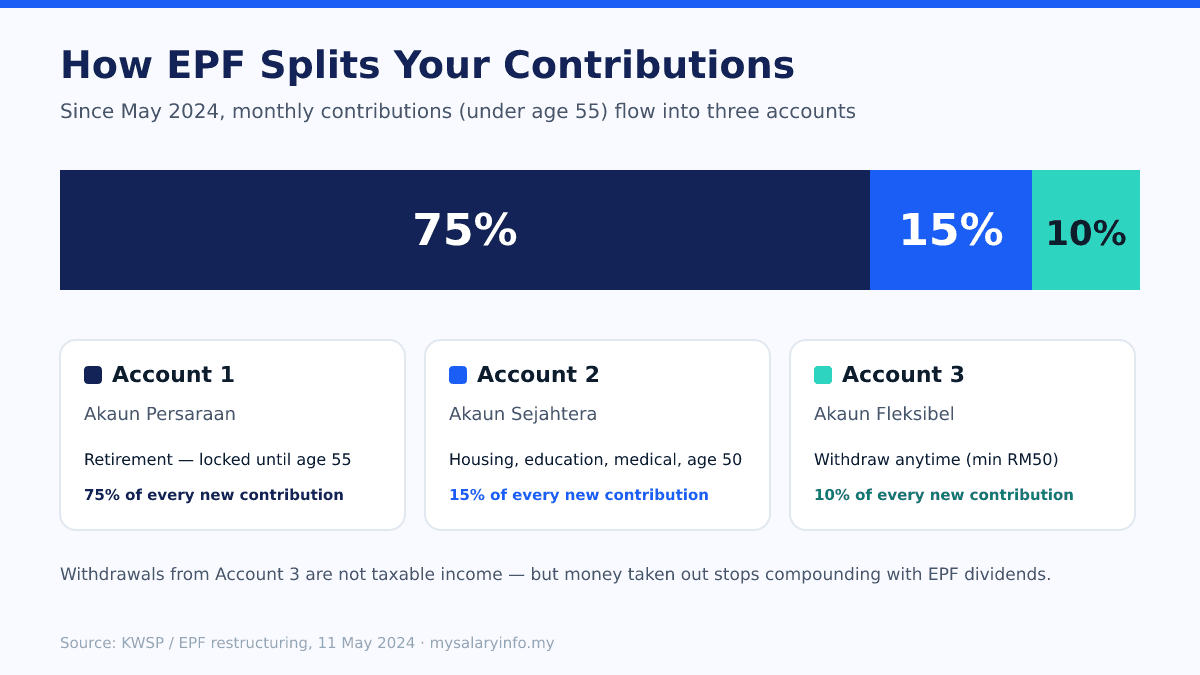
Since 11 May 2024, EPF has split members' monthly contributions into three accounts instead of two. The new one, Account 3 (Akaun Fleksibel), can be withdrawn at any time for any reason. That's handy in an emergency, but it's also easy to drain without noticing what it costs your retirement.
Here's how the three accounts work, whether withdrawals are taxed, and where EPF tax relief comes in.
Key points
- Since 11 May 2024, new EPF contributions are split 75% to Account 1, 15% to Account 2 and 10% to Account 3.
- Account 3 can be withdrawn any time, for any reason, from RM50.
- EPF withdrawals from any account are not taxed.
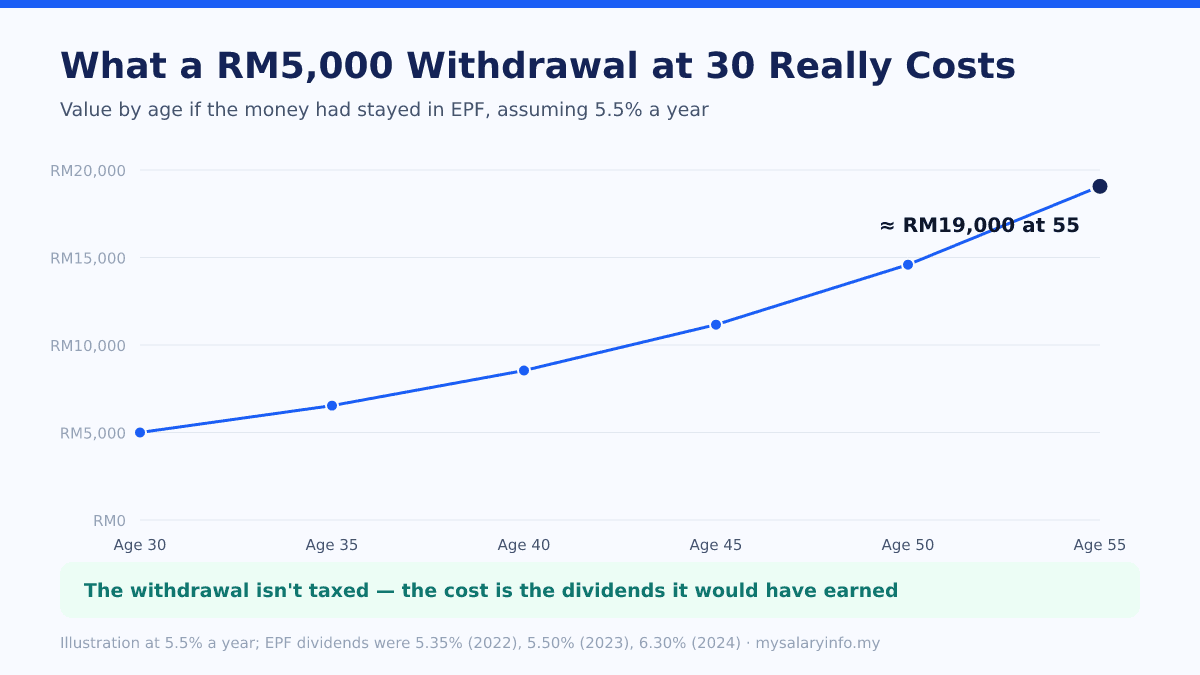
- The real cost of a withdrawal is lost dividends. RM5,000 taken out at 30 could have grown to about RM19,000 by 55.
- Mandatory EPF can fill the RM4,000 category, while qualifying additional voluntary EPF may still use unused capacity in the separate RM3,000 life insurance / voluntary EPF category. Do not double-claim.
How your contributions are split
For members under 55, every new contribution (yours plus your employer's) is divided like this:
- Account 1, Akaun Persaraan (75%): retirement savings, locked until 55.
- Account 2, Akaun Sejahtera (15%): withdrawable for approved purposes such as buying or paying off a house, education, medical treatment and reaching age 50.
- Account 3, Akaun Fleksibel (10%): withdraw any time, for anything. The minimum withdrawal is RM50.
The split applies to contributions from May 2024 onwards. When Account 3 was launched, members could choose to make a one-off transfer from Account 2 to start it off. If you didn't, your Account 3 simply started from new contributions.
All three accounts earn the same annual dividend.
Are Account 3 withdrawals taxed?
No. EPF withdrawals, from any account, are exempt from income tax under Schedule 6 of the Income Tax Act 1967. You don't declare them on your Form BE and there's no withdrawal tax.
EPF is tax-friendly at both ends: contributions reduce your tax through the EPF relief, and withdrawals come out tax-free.
What Account 2 can be used for
Account 2 (Akaun Sejahtera) isn't as flexible as Account 3, but it covers a lot. Approved withdrawals include:
- Housing: a down payment on a home, monthly loan instalments, or reducing or paying off a housing loan
- Education: fees for yourself, your spouse or your children at approved institutions
- Health: treatment for critical illnesses and some medical equipment
- Age 50: a withdrawal of any amount from Account 2
- Hajj: limited amounts to cover the cost of performing the hajj
Each has its own conditions and paperwork, listed in the KWSP app. Account 1 stays locked until 55, apart from limited cases such as leaving the country permanently, incapacity or death.
How to withdraw from Account 3
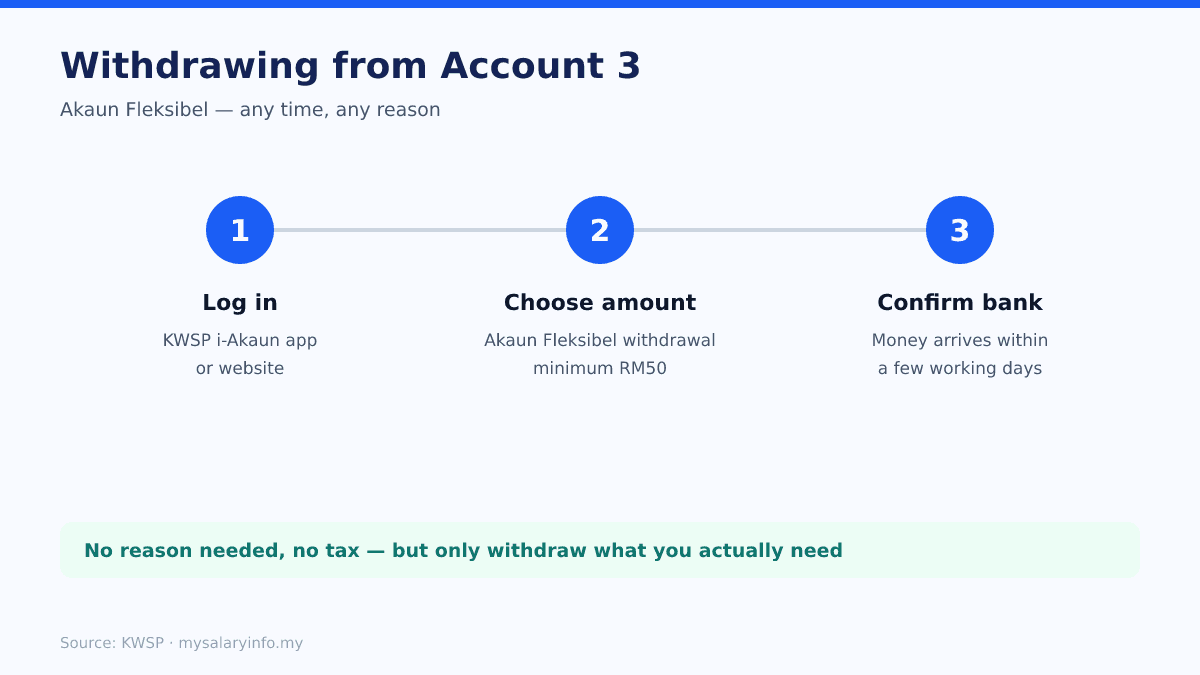
1. Log in to the KWSP i-Akaun app or website. 2. Choose the Akaun Fleksibel withdrawal option and enter the amount (at least RM50). 3. Confirm the bank account the money should go to.
The money usually reaches your bank account within a few working days. You can withdraw as often as you like, as long as there's at least RM50 in the account. You don't need to give a reason.
What a withdrawal really costs
Tax-free doesn't mean free. Money you take out stops earning dividends for all the years until you retire.
Say you're 30 and withdraw RM5,000. EPF's dividend has ranged between roughly 5% and 6.5% in recent years. If that RM5,000 had stayed in and grown at 5.5% a year, it would be worth about RM19,000 at age 55. That's what you're really spending.
That doesn't mean never touch it. Account 3 exists for real needs like a medical bill, a car repair you can't avoid or a gap between jobs. It's a poor way to pay for a holiday or a new phone.
Before you withdraw: three questions
1. Is this a real need or a want? A medical bill or a job loss is a need. A gadget or a holiday usually isn't. 2. Is there another way to cover it? A savings account, a cheaper option or waiting a month may do the job without touching your retirement money. 3. How much do I actually need? Withdraw that amount, not the whole balance. Whatever you leave keeps earning dividends.
If the answer to all three still points to Account 3, withdraw with a clear conscience. That's what it's there for.
EPF tax relief: who benefits from a top-up?
For YA 2025, HASiL lists two separate limits:
- Up to RM4,000: mandatory contributions to approved schemes or voluntary EPF contributions.
- Up to RM3,000: life insurance premiums, family takaful or additional voluntary EPF contributions.
At an 11% contribution rate for 12 months, mandatory EPF reaches RM4,000 at a monthly salary of about RM3,030. That uses the first category, but qualifying voluntary top-ups may still use unused capacity in the second category. Do not claim the same contribution twice.
For example, if mandatory EPF already uses the RM4,000 category and you have RM1,000 of eligible life insurance premiums, up to RM2,000 of qualifying additional voluntary EPF could fill the remaining RM3,000 category. A deduction only saves tax where there is tax to reduce.
In the yearly calculator, enter the allocated amounts in the EPF field and the life insurance / additional voluntary EPF field. Check the applicable year and conditions in HASiL's tax relief schedule.
How dividends work across the three accounts
EPF declares one dividend rate each year, usually in February or March, and credits it to all three accounts on the same basis. The conventional dividend was 5.35% for 2022, 5.50% for 2023 and 6.30% for 2024. Simpanan Shariah rates are declared separately and are usually a little lower.
Dividends are calculated on your daily balance, so money withdrawn in June still earns dividends for January to June. It just stops earning from the day it leaves. There's no penalty for withdrawing. The cost is purely the growth you give up.
A sensible way to use Account 3
- Treat it as a backup emergency fund, not spending money.
- If you have to withdraw, take only what you need.
- Keep a separate emergency fund in a savings account if you can, so Account 3 stays untouched.
- Check your balance and dividend history in the KWSP app once a year.
To see how your EPF deduction affects your take-home pay and tax, try the PCB calculator. It shows your monthly EPF alongside PCB, SOCSO and EIS.
Common questions
Does withdrawing from Account 3 affect my EPF tax relief? No. Relief is based on what you contribute in the year, not on your balance or withdrawals.
Can I move money back into Account 3? Not directly. New contributions are split 75/15/10 automatically, so voluntary contributions put 10% into Account 3 and the rest into Accounts 1 and 2.
What happens after 55? The three-account split applies to members under 55. After that, contributions and savings are handled under separate rules. Check KWSP's current guidance as you approach 55.
Check the official sources
Check the applicable assessment year and eligibility conditions. Calculator estimates do not replace the official schedules or guidance.